

Which Bluetooth speaker should you buy? What the watts, the IP rating and the battery tell you
50 watts does not sound ten times louder than 5 watts, IP68 does not mean the warranty covers water, and battery hours are measured at medium volume. What to check in the specs before you buy a Bluetooth speaker.
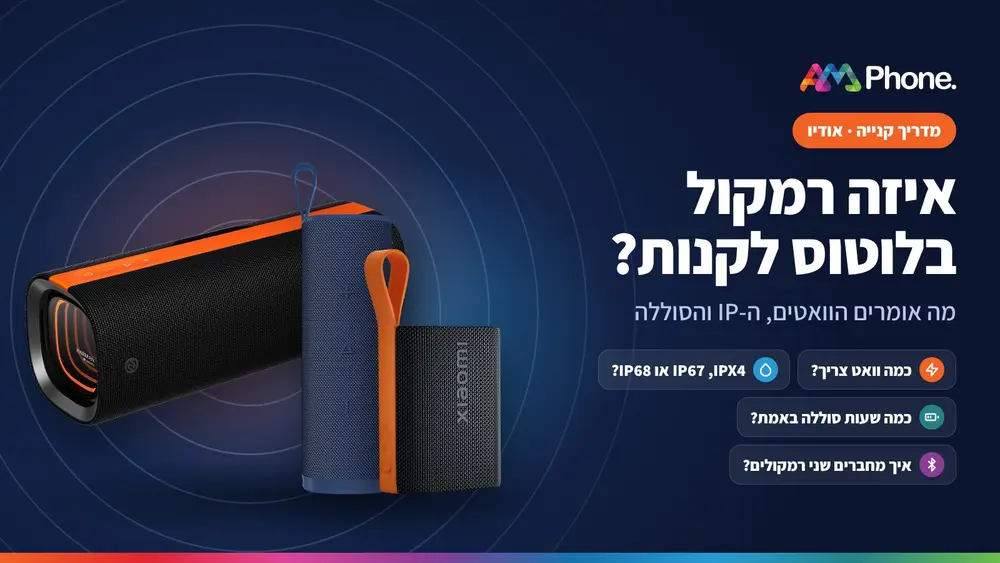
A Bluetooth speaker's spec sheet has three numbers that decide whether it suits you: watts, the water-resistance rating and battery hours. Each one comes with its own measuring conditions, and without knowing them it is hard to compare two speakers.
How many watts does a Bluetooth speaker need?
Watts measure the amplifier's power, not how loud the speaker sounds. Doubling the power adds about 3 dB, a small difference to the ear. For a speaker to sound roughly twice as loud, you need about 10 dB more, which means ten times the power. So, all else being equal, a 50 W speaker sounds about twice as loud as a 5 W one, not ten times as loud.
What size does change is the bass. A small Bluetooth speaker like the 5 W Xiaomi Sound Pocket suits a room, a desk or the shower. The 50 W Xiaomi Sound Party has a separate woofer for the bass, and that is the difference you will hear on a balcony or in a yard.
A water-resistant speaker: what is the difference between IPX4, IP67 and IP68?
The first digit after the letters IP describes protection from dust and sand, and the second describes protection from water. An X in place of a digit means the speaker was not tested in that area, so IPX4 says nothing about sand. A 6 in the first digit means fully dust-tight. In the second digit, 4 means splashes from any direction, 7 means immersion up to 1 m for 30 minutes, and 8 means prolonged immersion under conditions the manufacturer sets.
A shower speaker gets splashes, so a 4 in the second digit is enough. By a pool or at the sea, where it might fall into the water, 7 or 8 is better, plus a 6 in the first digit if there is sand. The soundcore Boom 3i, for example, is rated IP68 and also floats on water.
The rating describes a lab test, not the warranty terms. The specs of the Boom 3i and the soundcore Select 4 Go state explicitly that water damage is not covered by the warranty, despite IP68 and IP67. Next to IP67, Xiaomi notes that the speaker is not meant for immersion in a pool or the sea.
How many hours does the battery really last?
Manufacturers measure battery life at medium volume, not at full volume. The soundcore Boom Go 3i is listed at up to 24 hours at 50% volume with BassUp and the lights off, and up to 40 hours at the same volume in Eco mode. Xiaomi lists the Sound Pocket at about 10 hours at 40% volume. At full volume, with boosted bass and lights, the battery runs out sooner.
When you compare two speakers, compare hours measured at the same volume. A number of hours with no volume next to it can't be compared.
How do you connect two Bluetooth speakers?
The common way is through the speakers themselves. Two speakers of the same model pair as a stereo pair (TWS): one plays the left channel and the other the right. Party mode connects more speakers to the same song. On the Boom 3i the technology is called PartyCast 2.0, and it connects 100 or more compatible speakers. The connection works only between models the manufacturer has defined as compatible, so before buying a second speaker, check that it is on the compatibility list.
The second way is through the phone. Samsung Galaxy phones have a feature called Dual Audio, which plays the same audio to two Bluetooth devices at once, and no more than two. On an iPhone, Apple's audio sharing is for two pairs of AirPods or Beats.
You can compare our speakers, with each one's IP rating and battery time, on the Speakers and Bluetooth page.
- bluetooth speaker
- waterproof speaker
- portable speaker