

Fast Charger for iPhone and Samsung: How Many Watts Your Phone Really Gets
The iPhone 17 doesn't charge faster than with a 40W charger, Samsung needs PPS and not just watts, and an ordinary cable tops out at 60W. Three lines to check before buying a charger, and a quick calculation for a power bank on a flight.
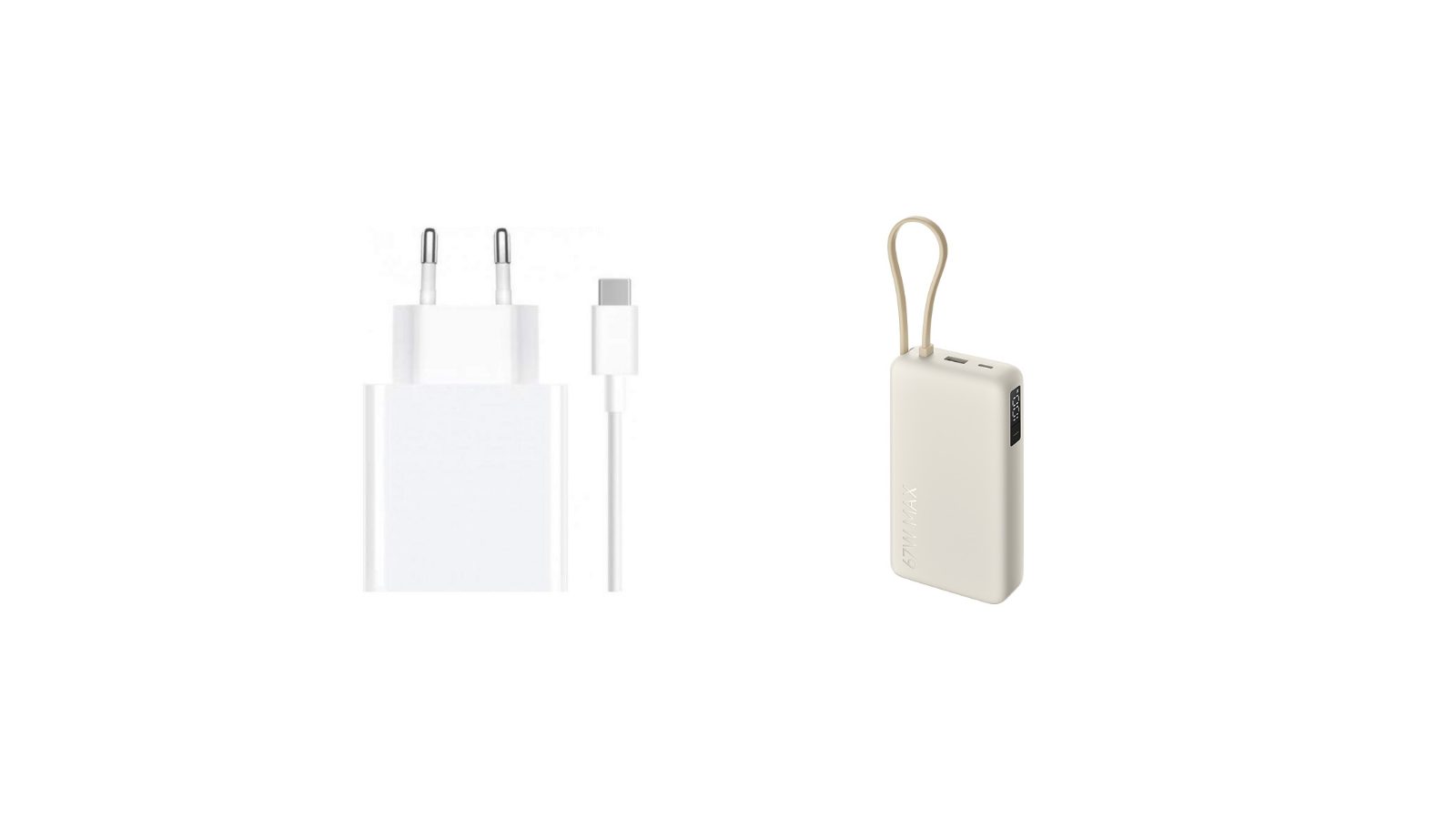
Every charger has a big wattage number printed on it, but it's the phone that decides how much of it to take. A 100W charger won't charge an iPhone faster than a 40W one, and a 65W charger won't always trigger Samsung's fast charging. Three small lines determine the speed: the power the phone supports, the protocol, and the cable.
How many watts does an iPhone 17 need?
According to Apple, the iPhone 17, 17 Pro and 17 Pro Max charge up to 50% in about 20 minutes with a 40W or higher adapter and a USB-C cable. The iPhone 17e needs only a 20W adapter, and then reaches 50% in about 30 minutes. Beyond that power, the phone simply doesn't draw any more, so there's no reason to pay for a 100W charging brick just for the iPhone.
For wireless charging, MagSafe and Qi2 on the iPhone 17 go up to 25W, but only when the wireless charger is connected to a 30W or higher adapter. A charging pad plugged into an old 5W or 12W brick will charge slowly, even if 25W is printed on it.
Fast charger for Samsung: what is PPS?
For the Galaxy S26 Ultra, Samsung specifies fast charging of up to 60W, provided the charger supports PPS, a protocol in which the charger adjusts the voltage during charging. A charger labeled 60W or 65W without PPS will still charge, but not in Samsung's fast-charging mode. That's why, when shopping for a Samsung charger, you look in the specs for the words PPS or PD3.0 (PPS), and not only the wattage. On the pages of some Xiaomi power banks, for example, this protocol is written explicitly in the compatibility list.
The cable matters as much as the charger
A standard USB-C cable carries up to 3 amps, which means up to 60W. Above that you need a 5-amp cable, usually marked 100W. On a charger with several ports, the power is split: when you plug in a phone and earbuds together, each gets less than the number on the box. And a GaN charger isn't a different kind of charging. It's a material that lets you build a powerful charger in a smaller body.
If you bought a powerful charger and charging is still slow, check the cable first. A 100W USB-C cable is the simple way to make sure it isn't the bottleneck.
Power bank on a flight: a quick calculation before you pack
A power bank can go on a plane only in your carry-on, and without special approval only up to 100Wh. Most power banks are labeled in mAh rather than Wh, but the math is simple: multiply the mAh by 3.7 and divide by 1,000. A 20,000mAh power bank comes out to about 74Wh, which is within the limit. It's important that the figure is printed on the power bank itself. Some airlines, El Al among them, also prohibit using the power bank during the flight, so check the airline's rules before you travel.
You can compare chargers and cables in chargers and cables, and power banks in power banks. On every page, look for three lines: output power, protocols, and the cable in the box.
- Fast charger
- iPhone charger
- Samsung charger
- Power bank